-
How to Write a Resignation Letter

Are you ready to quit your job? If so, I recommend writing a letter of resignation to formalize the details of your retirement. But what is a resignation letter and why should you write one? What should it contain and when should you notify your future former employer? Resignation letters are one of the excellent methods to formally exit an enterprise with a tremendous tone and give a boost to your dating with the organization and your co-people in future. When written honestly and with polish, a properly-crafted resignation letter is one of the most stable stepping stones for your professional career
What’s A Resignation Letter?
A resignation letter is a professional report that records the stop of your employment with an agency if you have indicated your selection to leave. It’s always exceptional to talk immediately with your manager earlier than sending a resignation letter to offer them time to prepare. If you work remotely, ask for a communique via video chat or smartphone. In this text, we discuss how to write a resignation letter.
Should an employee write a letter of resignation?
Whether it’s a hospital job or a coffee shop job, you should always provide a resignation letter before leaving because it’s your job. A resignation letter formally tells your boss that you are leaving your job and that you need to hire someone to take over your responsibilities in your place. Simply put, don’t go without it.
Checklist of Resignation Letter
An official resignation letter should always have the following content.
- Current Date
- Company Name and Address
- Termination Notice
- Last Date
- Two Weeks Notice
- Title
- Appreciation for Opportunity
- Offer of Assistance During Transition
- Name and Signature
The Right Way to Write A Resignation Letter
Earlier than writing a resignation letter, the employee should visit their direct supervisor or HR supervisor to follow any techniques your enterprise has in location. For instance, they may ask you to provide precise facts or send your letter to certain human beings at the organization.
1. Document the time and date:
In a fashionable enterprise letter, the time, date and few different information are commonly covered to preserve report of timestamps. In an email, this information isn’t always vital as it is included digitally.
2. Begin with the address line:
Address in the recipient’s name. You can use an introductory phrase such as “Dear Sir or Madam”, “Hello”, or simply “Mr./Mrs. [manager’s last name]”.
3. Please attach your resignation statement:
Clearly state that you are writing to submit your formal resignation from the company. You can also enter your job title if you wish.
4. List subsequent steps or vital statistics:
listing any key information the recipient has to be privy to regarding your transition. this information may be worked out along with your manager beforehand.
5. List your last days at work:
Two weeks’ notice is common, but your company may have specific instructions as to when your last working day should be. After receiving this information, please indicate the date and day of your last working day at the company.
6. Along with a thank you note:
Keeping your relationships positive is always a good career decision.To encourage a peaceful transition, describe in a sentence or two what you appreciate while at the company.
7. Sign and conclude:
Finally, conclude the letter by signing after a closing sentence such as “Thank you” or “Sincerely.”
What not to include in a resignation letter?
The key is to maintain diplomacy. Don’t turn your resignation letter into a complaint list. At some point you may want to return to the company, and later meet your current boss professionally. At the very least, you may need to ask your employer to provide a letter of experience or recommendation. So keep your letter bright and witty.
- Do not explain your reasons for quitting.
- Do not make fun of your job, your co-workers, or your company’s downsides.
- Do not brag about what you’re going to do.
- Please do not send unedited letters with errors.
- Stick to the basics and keep it under one page.
Resignation Letter Examples
1. Termination Due to Job Change
Please accept my termination on [your last business day]. I have accepted a position for [insert intended field of work]. I will miss working with you, but I am excited about the new direction of my career.
Thank you for your support and opportunity through [insert years of service]. Let us know if you need help during this transition period and how we can help in the coming weeks.
2. Resignation due to further studies
Please receive my resignation effective [insert your final day of work]. Next month, I will be enrolling in graduate school and will be required to resign from my function at employer XYZ.
I would love to thank all of the remarkable opportunities I have had while running with this team. The studying stories and talents I’ve evolved at the same time as at company XYZ have laid the best foundation for this new degree in my life.
Please allow me to recognize in case you need any assistance all through this two-week transition. Thanks once more for all the high-quality studies during the last [insert duration you were at the company] and I look forward to staying in contact.
3. Termination for family reasons
Please accept my termination as of [last business day]. As you know, my family gave birth to our second child last month. After maternity leave, I want to stay at home with my kids and focus on my family’s needs.
Thank you for your understanding. Please let us know if there is anything we can help you with during this period.
Resignation Letter Tips
Here are some tips on how to write a resignation letter and how to write one effectively.
Stay positive: Whatever the reason for the dismissal, the tone of this letter should be positive. Aim for a good farewell and build a professional network. Above all, don’t use resignation letters to vent your frustrations.
Please submit the letter privately: If possible, submit your resignation letter to your boss. If you cancel in writing, be sure to include the date at the top of your letter. You can also send an email. Use a clear and direct subject line such as: B. Resign – [YOUR NAME].
Be concise, if necessary: If you are leaving the company for sensitive reasons and do not want to give out any information, please include a letter of resignation, your last days at the company, and a statement such as “I wish the company every success in its future endeavors.” Please enclose
Please plan to leave immediately: In some circumstances, employers may require you to leave the company on the day of termination. Heading into a new job that won’t start for a few weeks can mean going unpaid for a while.
Follow your manager’s instructions for next steps: After submitting a formal letter of resignation, your boss may ask you to create a transition plan, complete a particular project, or write a farewell note to a colleague.
When to Submit Your Termination Letter to Your Employer?
It is recommended that you send your termination letter well in advance of your departure. He recommends at least two weeks’ notice, unless circumstances require short notice or short notice. In some cases, we may not be able to provide notice. If you have a difficult job, have a family emergency, or otherwise have to move quickly, let your employer know as soon as possible given the circumstances. If you are considered a temporary worker, you are not legally obligated to give notice.
Conclusion
As you consider how to write your resignation letter, consider the following: The best way to cancel is to type the letter, print it, sign it and give it to the right person. If your human resources department has specific guidelines regarding termination, follow them. Thinking about quitting but haven’t found the right opportunity? Contact an engineering recruiter today or call a software developer recruiter.
-
A blog post on how to write a successful blog post.
Blog posts are important for marketing and advertising, but they’re also a great way to get your thoughts and ideas out there.
Blogging is an art, and you can’t just slop it off willy-nilly. There are many steps involved in writing a blog post that should be followed as laid out in this article.
This piece not only provides you with the most essential tips to be aware of when writing your next blog post but also tells you how to structure your content so that it has a flow.
Table of Contents- What is a blog post?
- 8 Essential Tips for Writing Successful Blog Posts
- 1. Blog posts should be well organized.
- 2. Be sure to include a link back to your blog posts.
- 3. Be concise.
- 4. Blog posts should be written in an active voice.
- 5. Use strong verbs in the blog posts.
- 6. Grammar and punctuation.
- 7. Use Powerful Words.
- 8. Use Images and Graphics.
- Conclusion
What is a blog post?
A blog post is a type of content that is typically written on a website. It is typically a short, concise, and informational piece.
When writing a blog post, it is important to keep in mind the following three key points:
- A blog post is a type of writing that is typically short and written in a concise manner. It can be about anything that interests you, whether it’s your life experiences, opinions on current events, or simply informational content.
- A blog post should be focused and have a specific purpose. One way to make sure your blog posts are successful is to figure out what you want readers to take away from them. This might mean answering key questions or providing helpful tips.
- Be sure to use strong language and visuals when writing your blog posts. This will help engage readers and help them understand what you’re saying. Finally, make sure to update your blog posts regularly so that readers can always keep up with the latest information.

8 Essential Tips for Writing Successful Blog Posts
Before you even start writing, you need to have an idea for your post. If you don’t have something to write about, it will be difficult to get your words on paper.
When it comes to writing a successful blog post, there are a few essential tips that you should keep in mind. Here are 8 important tips to help you write a great blog post:
1. Blog posts should be well organized.
Make sure your blog post is well-organized. Start by outlining your main points, and then structure your content accordingly.
2. Be sure to include a link back to your blog posts.
Always include a link back to your website in your blog posts. This will help people learn more about you and your business, as well as connect with you on social media platforms
3. Be concise.
Keep your blog post short and to the point. You don’t want readers to feel overwhelmed by your content, so keep it concise and to the point.
4. Blog posts should be written in an active voice.
Use an active voice when writing your blog post. This will make your writing more engaging and easy to read.
5. Use strong verbs in the blog posts.
Use strong verbs to convey action and emotion in your blog post. For example, use “wrote,” instead of “wrote a letter” whenever possible. This will create a stronger sense of action and emotion in your writing.
6. Grammar and punctuation.
Use effective grammar and punctuation in order to improve the readability of your blog post. Incorrect grammar can make your writing difficult to understand.
7. Use Powerful Words.
When you write for an audience, use words that will resonate with them. The key to using powerful words is to find the right language and to use it in the right way. For example, don’t use jargon when a less technical audience may not understand it. Instead, explain concepts in a way that everyone can understand.
8. Use Images and Graphics.
When possible, use images and graphics to illustrate your points. Not only do they add visual appeal to your blog post, but they can also help to engage readers.

Conclusion
Writing a successful blog post can be a daunting task, but with the right tips in mind, it’s definitely achievable. In this article, we’ve outlined essential steps that will help you write a strong and well-crafted blog post. Whether you are a novice blogger or an experienced one, following these tips will ensure that your readers will enjoy reading your work. Thanks for reading!
For more information, visit the Podium School Blog.
-
The Ultimate Guide to Hiring a content writer
Hiring content writers can be tough.. Even for professional writers, it isn’t all that easy to write quality pieces on a consistent basis in the time allotted for you. If you’re hiring a content writer, take this “How To Hire A Content Writer” guide and find out what you need to know!
Table of ContentsWhat Are Content Writers?
Content writers are the people who help you create and publish content on your website. In other words, they’re responsible for turning your ideas into articles, blog posts, and social media posts that help drive traffic to your site.

The Best Ways to Hire a Content Writer
There are many ways to find a content writer for your blog, but finding the best way to go about it can be tricky. In this article, we’ll help you figure out the best way to find and hire a content writer for your blog.
1. Start by brainstorming your goals for your blog and what you want to achieve. This will help you determine what topics are most relevant to you and which topics would be best suited for a content writer to contribute to your blog.
2. Once you’ve determined which topics are most relevant to you, start searching online for content writers who specialise in those topics. You can use websites like Elance or Craigslist to search for content writers who specialise in writing about specific topics. You can also look through directories of freelance writers or search for specific keywords related to your goal or topic.
3. Once you’ve found a few content writers who specialise in the topics that interest you, reach out to them and ask if they’d be interested in writing for your blog. Explain how you came across their work and why you think their writing would be a good fit for your blog. Let them know that you’d be happy.
How Much Do Content Writers Charge?
Hiring a content writer can be expensive, but there are ways to keep costs down. Here are the top five tips for finding a content writer who’s right for your project:
1. Start by researching prices.content writers typically charge per 500 words or per 1000 words, with an occasional exception. Try to ballpark how much you think you need before you start looking, so that you have a realistic estimate of what to expect.
2. Don’t be afraid to ask around. Many businesses and agencies have relationships with freelance writers, and they may be willing to refer someone you contact. Another option is to search online for content writing services that offer a discounted rate for bulk orders (i.e., 10,000 words or more).
3. Don’t be afraid to negotiate. If the price quoted is too high, don’t be afraid to ask for a discount – especially if you plan on using the writer repeatedly in the future. And be prepared to offer payment in several instalments, if necessary – hire a writer to help avoid any potential misunderstandings or delays in delivery.
4. Be realistic about what you can expect from the content writer.
Tips for Writing an Adorable Job Description
1. Begin by defining your target audience. Who are you content writing for? What are their needs and wants? Once you have a good idea of who you’re writing for, start to think about what they would want to read on your blog. Are you creating content that is helpful and informative, or entertaining and engaging? Write down some ideas of topics that may be of interest to your target audience.
2. Next, think about what you’d like to say. Once you know your topic, start brainstorming ideas for how to present it in an interesting and engaging way. Brainstorm until you have at least five potential article ideas that will fit the bill.
3. Once you have a few promising article ideas, begin drafting them together into a cohesive piece. Start by creating an outline, then filling in the details as you write. Be sure to include clear, concise language that will capture the attention of your target audience.
4. Once your article is finished, make sure to proofread it carefully before submitting it to your blog publisher or editor. Incorrect grammar and typos can often lead to decreased readership.

Hire the Right Talent
Finding and hiring a content writer can seem like a daunting task, but with the help of this guide, you’ll be able to get the perfect writer for your needs in no time at all.
When looking for a content writing, there are a few things you should keep in mind. First, make sure that the person you choose is qualified for the job. Make sure they have experience writing quality content and that their style is compatible with your own. Second, be sure to set clear expectations from the outset. Make sure you know what type of content you would like written, as well as any deadlines. Finally, always pay your writers on time and ensure that their work is of high quality. With these tips in mind, hiring a content writer will be a breeze!
Conclusion
Whether you’re just starting out and need help finding the right content writer, or you’ve been using a content provider but want to switch to an in-house team, this guide will provide everything you need to know. We’ll outline the different types of writers available on the market today, as well as give tips on how to find and evaluate them. In the end, we hope that this guide has given you enough information to make an informed decision about who to hire for your next content project.
For more information, visit the Podium School Blog.
-
How to Write an Essay
Essay writing is an important skill for all phases of life be it student life or later. To write a good essay, understanding the procedure of writing is important. To make a good essay, give it a structure that when followed can give a great experience to the writer as well as the reader.
What is an Essay?
The definition of an essay is a certain piece of write-up which describes a subject or an idea, validating its theories through benefits, problems, solutions, questions, and answers. Writing an Essay is required in various places like schools, colleges, and research institutes to portray an idea properly. The main body during writing an essay can be divided into further subheadings which gives clarity to the content.
Types of Essay
Essays can be broadly broken into types based on tone, language, content, and purpose. Details regarding each type of essay along with the process to write an effective essay is given below:
- Descriptive
Descriptive essay as the name suggests is written for describing an event a place, or an individual. A descriptive essay has a tone of vivacious rather than bland. Many times, the language used is dynamic to make the reading more interesting.
- Research
A Research essay is written to outline and give details of a research topic. The language and tone used are formal and analytical. Generally, research essays are written in the third person and contain references to previous research in the same field.
- Literary
A literary essay is written to analyze a piece of literature or critical evaluation of a literary piece or as a comparative study of two literary works. The language used is creative with various quotes and intonations.
- Persuasive
A Persuasive essay is written to convince an idea to the reader. Headings like “pros and cons” or “benefits” are used to support the idea. Using headings like “problems” or “cons” give validity to the idea. Includes verdict based on personal opinion.
- Expository
An Expository type of essay gives a detailed description of the topic of the essay in a way that covers both positive and negative aspects. An expository essay should not be confused with descriptive or persuasive types of essays. The personal opinion of the author is included but there is no verdict.
How to write an essay?
- Choose a topic for writing an essay
This is the first and most crucial thing to do before starting the writing. If being blank about the topic is the problem, then start with the purpose of writing an essay. Once the purpose of writing an essay is sorted, referring to the types of English essay writing is a good idea.
- Research the topic
Once the topic is final, researching it is inevitable. This research includes quotations, statistics, and data related to the essay topic. Including tables, and visuals make the work of writing the essay easy. At this level, information is for personal use so any data that seems relevant should be noted. If the essay is on personal experience, jot down the whats, hows, and whys of the event.
- Sorting the information
Once all the data is collected, sorting needs to be done to avoid confusion while writing the essay. Putting tags while sorting, makes the process easier. Sort what will go into relevant headings and sub-headings. In a personal essay writing format writing events and opinions in chronological order is to be done.
- Start writing
Delaying the process any further will result in loss of information. Many facts and figures are written down while researching but many things are relevant but not noted down.
- Prepare the structure
To write a good essay, preparing a structure that involves writing down all the headings and sub-headings is important. Once the structure is ready, it is easier to fill in the details to describe the points.
Structure of an Essay:
Any essay writing format has Headings and sub-headings depending upon the type of essay. The structure mainly includes the following things:
- Introduction
Introduction of an essay, introduces the topic and it makes readers understand what will follow next in the essay. It is the first part to be read so make it powerful with appropriate phrases and quotations. The length of an introduction should be around one-fourth of an essay or less.
- Description
Description is the second part of an essay and gives details about the topic. The description is where headings and subheadings are included. Some interesting events during the life of that person. Mentions and details about what inspired that person. Biggest achievement or contribution to society by that person. Progress in steps and main struggles faced by the person. All this will make for an interesting description.
- Conclusion
Conclusion is simply a summary of all that is written in the Introduction and description. Care needs to be taken that it should not repeat words from the earlier paragraphs. Instead, a small fact that is not in earlier paragraphs can be used to it better. Make sure that the tone of the Introduction and description should match. If the Intro and description support some idea, the same needs to be done in the conclusion.
Top books to write essays
S. No. Book Name Book Description 1. Fundamentals of Essay Writing and Answer WritingBy Anudeep Durishetty Fundamentals of Essay and Answer Writing is specifically designed to improve answer and essay writing skill in a short time.For a beginner, you will take considerable time to understand the nuances of the exam. The principles outlined in the book will help to overcome hurdles fast and easy.For a seasoned aspirant, find new tools to further develop and effectively improve the quality of answers. 2. Junior’s Handbook of Essays, Letters, Paragraphs and Precis Writing Paperback This book has been prepared to help students to develop their ability to structure their thoughts and ideas logically and enhance their writing abilities. The huge variety of subjects covered in the book will help the students to become better writers and pen down their thought more properly and confidently. 3. Essays and Letters for Senior Classes (Two Colour) This book is designed to cater to the need of the students at school level, college level, Boards and ready for recruitment toa variety of services throughout the country. Essay Writing Interesting Points about writing essays:
- Maximum number of people have to do an English essay writing course to write good essays at academic levels.
- Many students opt for content writing services to write essays for their assignments.
- Writer’s dilemma is faced by everyone at some point in time.
End note
Writing an essay is not that hard if the right resources are used. Internet is at a fingertip and knowledge is everywhere. The essay writing format is like a magical quest where new questions emerge at every turn. Answering those questions with integrity is the utmost requirement. If this is all too much, help is always at hand with content writing services, which will help with college assignments and essay writing services. Get in touch with us for professional content writing for your requirements. Learn More

-
How To Write A Notice
 Jump to Section
Business communication, usually referred to as formal communication, is a crucial component of communication. Formal correspondence includes memoranda, circulars, and other written documents. A notification is still another crucial tool of the same. Let’s discover the definition of notices and the specifics of notice writing.
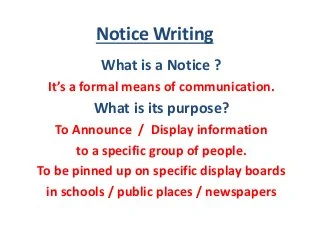
Notices writing are a type of official communication directed to a specific individual or group of individuals. This can be used to issue instructions, appeals, announcements of events, invitations to meetings, etc.
It is usually written down and then put on display in a position where everyone can see it. They may be taped to bulletin boards. Even publishing it in a newspaper is an option if it is intended for a larger audience. When the government issues notices, it is required to publish them in local and national newspapers.
What is Notice Writing?
Notice composing is the proper letter to show data about government and confidential associations. This notice is given by the power to illuminate people in general about any issue, for example, strategy changes, new guidelines or guidelines, significant declarations, and so on.
Notice composing is an authority letter and it ought to be written properly. The notification ought to likewise be brief and clear. It ought to contain just significant data to stay away from disarray among perusers.
Sorts of Notice Writing
Notice Writing can be separated into four classifications.
1. Authoritative Notices:
These depend on the administrative demonstrations of parliament or some other administrative body. They are distributed to make individuals mindful of the impending regulation or guidelines connected with them.
2. General Notices:
These are given by different specialists and associations like the police, armed force, court, and so forth. General notifications are vital as far as giving data about different occasions, exercises, and happenings connected with these specialists and associations.
3. Closeout takes note:
These are utilized for auctioning off property that is being unloaded for non-installment of charges and so on. Barters are generally held at government structures where potential purchasers can see things available to be purchased before proposing procurement.
Significances of Notice Writing
Notice composing is significant expertise and it is normal for the majority of us to compose sees consistently. Notice composing can be characterized as the most common way of conveying messages or warnings to individuals who might be keen on something similar.
A notification might be composed on any point, yet it is generally utilized for illuminating the perusers about significant occasions, gatherings, advancements, and other data that might be valuable for them.
What is the Format of Writing Notice?
Notices should adhere to a structure or format because they are formal documents. Remember that there is no one rigidly correct format. Variations may be seen depending on the forms utilized by various individuals or groups. But for clarity and uniformity, it is best to stick to a roughly similar format. Let’s examine the notices’ most popular format.
1. Name of Issuing Organization/Authority:
You print the name of the person or business that issued the aforementioned notices right at the top. This will make it easier for the reader to decide whether or not the notices are significant to him.
2.Notice
The word “NOTICE” is used as the title when writing notices. This makes the document more noticeable. Ordinarily, notices are put in a public area or printed in newspapers. Students must avoid drowning in a sea of knowledge. Therefore, a bold title with a clear mention aids in grabbing attention.
3. Date
After the tile to the left-hand side we print the date on which the notification has been distributed. Since this is a conventional report date is a significant part of it since these archives stay on record.
4. Heading
Then we continue toward a suitable making a beeline for the note. This heading ought to make crystal clear the motivation behind the note.
5. Body
After the heading, we compose the brief and to-the-point body of the notification. The fundamental substance of the notification is highlighted in the body.
6. Essayist’s Name:
At the finish of the notification we compose the name and assignment of the notification author. The notification needs to likewise be endorsed by a similar individual to loan it authority and legitimacy.
Content
1. What?
What is the notification about? The notification ought to be clear about the thing that will occur (occasion), or what has proactively occurred (event). This is the core of the message and ought to be composed obviously. There ought not to be any uncertainty.
2. Where
If the notification is about an occasion, then the area of such an occasion should be composed obviously. The setting of the area has significant subtleties, so try to remember this for the notification.
3. At the point when:
This is the time and the date of the occasion or meeting. Assuming that conceivable the length of the occasion ought to likewise be referenced to individuals can plan their time as needs are.
4. Who
This will be to whom the notification is addressed. What all’s identity is assumed to stick to the notification ought to be referenced to keep away from disarray.
5. Whom
And last detail ought to be whom to contact or reach out to. This notices who the suitable authority is to contact.
Tips to Keep in Mind When Writing a Notice
- Be succinct and precise. The ideal notice is 50 words long, thus being specific in your phrasing is desired.
- Given that it is a formal method of communication, the language chosen should reflect this. No flowery text.
- Use basic language and brief sentences whenever possible. It’s important to keep things basic because notices are typically rather brief.
- As much as possible, avoid using active voice.
- Present your notices in a box using the correct format. The display should be tidy and aesthetically pleasing.
The following are a portion of the advantages of notice composing:
1. Notice Writing Helps in Increasing Awareness:
When you compose a notification, it implies that you are writing your contemplations down. You can communicate your perspectives and offer data to others through composition. Thus, you will want to increase mindfulness about various things. It likewise helps in advancing a message or thought among individuals.
2. Notice Writing Helps in Creating Interest:
Writing a notification can assist in making fascinating individuals about something vital to them. For instance, if you need to illuminate individuals about an impending occasion or something going to happen soon, then, at that point, composing a notification is the most effective way to get it done. This will help you in making interest among individuals and make them find out about what is happening around them.
3. Notice Writing Helps in Improving Quality of Products or Services:
The nature of items and administrations relies upon different elements like material utilized, legitimate bundling, and the transportation framework utilized for delivery of merchandise starting with one spot and then onto the next. Everything can be made sense of by utilizing appropriate notification composing strategies so clients know the precisely exact thing they are purchasing from you.
4. Notice Writing Helps in Creating a Positive Image:
The notification which is composed by a business should be positive with the goal that it can make a positive picture of the organization before the representative.
5. Notice Writing Helps in Keeping Record of Events:
If you need to monitor specific occasions that occur in your office on an ordinary premise, then, at that point, you can do as such by composing a notification and putting it on the notification board inside the workplace premises where all representatives can see it without any problem.
6. Notice Writing Helps in Communicating New Rules and Regulations:
When there are new standards or guidelines which should be trailed by all representatives working in an association, then these principles ought to be imparted appropriately through sees so everybody becomes mindful of them and follows them as needs be.
Conclusion
As a result, businesses and other organizations use written notices to communicate with their staff members and others. It can be used to enlighten readers, make changes known, or elicit responses from them.
There are numerous formats for notice writing, and there are multiple varieties of notices. Being succinct and clear is the most crucial thing to keep in mind when writing a notification.
Get in touch with us for professional content writing for your requirements. Learn More.
-
How to Write a Report?
 Jump to Section
You may be working in the academic world or the business world, and writing reports is a quintessential part of the job. Knowing how to write and deliver the content effortlessly and effectively is a skill that you have to cultivate to perform efficiently in your job. You will be required to do a professional job of writing and you should know upfront what writing an effective entails. Reports are a visual display of your performance metrics and are a barometer of your on-the-job performance.

Report writing What is a report?
A report is a document that presents the results of a program, initiative or investigation in an easy-to-read form. It could also be an analysis of a data set or a particular issue. The purpose of a report is to present data, educate and set the parameters in front of the decision-making authority. This will initiate a decision or an action plan. Reports cover dozens of industries and also have dozens of formats depending on the type of the writing. The main sections can be subdivided into the following:-
- A detailed summary of the events or actions
- Analysis of the impact of the event or the action
- Evaluations of facts and/or data
- Prediction of potential outcomes of the preceding action
- Recommendations for the next course of action
- Conclusion
Whatever the industry, the occupation or profession of the person writing it. One fact is sacrosanct, the reports must be well-written, accurate and efficient in the delivery of the desired outcomes.
How to write a report: Steps leading to the creation of a perfect report
1. Understand the assignment:
You must understand what the report is about. Comprehending the assignment in all its nuances is vital. Also when you start to write a report, your views must be rational and objective. Subjective, personal views have no place in a professional or an official report. It must make its point clearly without the addition of too much fluff. It should be succinct and to the point.
2. Decide on the terms of the reference:
Understand what the report is about, why it is to be written, how it is to be written and what its purpose is. The terms of reference enable the reader to get a gist of what the document is about without having to read the entire document.
3. Research the subject matter of the report:
You must have a thorough understanding of the subject matter on which you are writing a report. You must first collect all the data, analyze it, organize it and then compile it. Research sources are available online as well as offline. Also, gather data as exhaustively as possible and should do an in-depth analysis of all matters that you are writing about. Interpreting and formatting in a way that all readers understand is key to writing a good report.
4. Make sure that all your online sources are reputable:
It is better to stick to experts’ opinions, government websites and other scholarly journals. Always attribute the source of the documents through a hyperlink and make sure that you quote the source.
5. Track all references:
Track all the references you are using and make sure that the material of the report is factual and accurate. All these have to be quoted as the source of the report.
6. Prepare a thesis statement:
Now that you have all the data and material with which to create the report, you can prepare a thesis statement which will be a short summary containing the bare skeleton of the material which is to be incorporated into the report. This could even be a series of sub-headings which tie back to the main report where they are used to demarcate different sections of the report. The report’s outline may have the following contents:
- Title Page
- Table of contents
- Introduction
- Terms of reference
- Summary of procedure
- Analysis
- Conclusion
- References and Bibliography
7. Create an outline of the report:
Create a short outline of the report. This will ensure that you do not get side-tracked from the subject matter while writing reports.
8. Write the first draft of the report:
The purpose of this document is not to create the perfect report from the get-go but to make sure that all data is compiled correctly. All your data and analysis together become the first draft. Reading through the , you may find gaps in your data or holes in your analysis.
9. Analyze the data and record the findings:
The finding is a very important section of the report. It culminates all your knowledge and interpretation of the data in the form of potential outcomes and an explanation for them. If the data was insufficient or the findings based on erroneous data were flawed, it should state the same. All the facts should be explained professionally and accurately.
10. Recommend a course of action:
After studying the data and the findings, you are qualified to present an idea as to possible actions which are triggered by the findings. Each course of action and possible outcomes should also be evaluated in order to present a complete picture.

Report writing tips Some helpful tips for writing the perfect report
1. Gauge your audience:
You must understand your audience and be able to anticipate their requirements in the report that you are writing. It should speak to your audience in the right tone and convey the right information
2. Proofread carefully:
Before giving reports, especially to top-level management and other stakeholders, proofread to remove spelling errors and data inaccuracies which may show in poor light.
3. Be receptive to feedback:
You may be called on to modify your report and change either outcomes or findings. Be open to criticism as this will help to improve. Getting input from someone who knows the subject matter better can only help to improve.
4. Ensure a goal-oriented report, especially while compiling a long-form report:
Make sure that you set targets either hourly or daily to ensure the delivery of the report on time. Adhere to the targets set while making sure that you are compiling the data accurately.
Types of reports
Reports can be classified as:
1 Marketing reports
2. Internal reports
3. External reports
1. Marketing reports:
Periodic reports: This is normally used to communicate marketing statistics and analysis to internal or external stakeholders. They are issued at regular intervals as they facilitate decision-making. The frequency of these reports could be monthly, quarterly or annual. Sales reports, email marketing, google analytics reports and social media reports all fall within this purview.
Analytical reports: Analytical reports share data and insight about the performance metrics and key performance indicators. They are business documents which share statistics, predictions and solutions. It is like a technical report on which the management bases its business decisions and action plans.
Marketing dashboards: They are a real-time type of report. It is like a function which is used to adjust performance. It shows the current status of most marketing strategies.
2. Internal Reports:
These are reports which are shared among members of the organizational team and employees of the organization to facilitate action plans. An example could be a Marketing budget sent to the Finance department for approval.
Short reports: These are reports used to announce a news event or internal changes within the organization. They are usually informal and less than ten pages in length.
Informational reports: These reports provide background about different company sectors. Annual reports, financial reports and accounting reports fall within its ambit. It could also be the minutes of a management meeting.
Proposal reports lay out a strategy and also explain potential outcomes. These reports are normally problem-solving reports with a project overview, solution and expected outcomes. An example of this type of report is a digital marketing from an advertising agency.
Vertical reports: As the name itself suggests, vertical reports communicate vertically up or down the hierarchy.
Lateral reports: These reports communicate sideways in an organization facilitating knowledge transfer.
3. External Reports:
These are normally used to announce an event or product launch or other happenings in a company.
Conclusion
Report writing has to become a part of everyone’s repertoire as our professional life and academic life demand the creation of regular reports. Become conversant in creating different forms of reports, not only short and long-form but also dashboards and graphical or pictorial representations.
-
How to Write Leave application?
 Jump to Section
- What is a leave application?
- 1. Annual leave
- 2. Parental leave
- 3. Medical leave
- 4. Family leave
- 5. Bereavement leave
- 6. Leave of absence
- 7. Half-day leave
- 8. Personal leave
- How to draft a leave application for leave
- 1. Examine the company’s rules
- 2. Select an appropriate subject line
- 3. Make a formal salutation
- 4. Introduce the leave application’s purpose
- 5. Mention pertinent information
- 6. Offer to deliver documentation if required
- 7. Show gratitude
- 8. Finish the leave application by signing it and adding the contact information
- Sample of a leave application
- Conclusion

Writing a Leave Application In most organisations, submitting a leave application to ask for permission to take time off is standard procedure. Although each organisation may have its policies and procedures for seeking time off, the general format for a leave application is typically uniform across all sectors. One can efficiently draft a leave application by being aware of how to do so. In this blog, the different types of leave applications have been discussed along with some examples.
What is a leave application?
Application letters for leaves are formal requests to the employer for approval of a brief absence from work. The application, which is typically in the form of a letter or email, should include an explanation of the reason(s) for the absence, the anticipated duration, and how the absence will not disrupt the team. When required by corporate policy, an employee might additionally need to submit supporting paperwork, such as a doctor’s note if they are taking a leave of absence for a medical condition.
Below mentioned are the various types of leaves available to a person:
1. Annual leave
If one hasn’t taken any vacation days this year, they can ask for some time off to use their paid time off. When the employer does not carry over the unused vacation time to the following year, employees typically take such leaves.
2. Parental leave
As a mother or a father who is expecting might need to take some time off for a few weeks or months to get ready for the baby’s birth or adoption. Some time off may also be needed for postpartum care and adjustment.
3. Medical leave
When ill or injured, a person may take a brief leave of absence that lasts anything from a day to a few weeks.
4. Family leave
A person may request family leave if they must care for a sick family member. The typical lifespan of these leaves is a few days or weeks.
5. Bereavement leave
When a family member or close friend passes away, one may ask for bereavement leave. Each organisation has its policy regarding this leave’s length.
6. Leave of absence
An employee may request a leave of absence if they are vacationing while travelling. To make sure they take the required minimum amount of paid time off, most employees schedule their vacation days around weekends or major holidays.
7. Half-day leave
An employee can request a half-day leave if they simply need a few hours away from work to fulfil an urgent assignment or run an errand. They can ask to arrive later than normal or to leave before the workday is through, depending on the schedule.
8. Personal leave
One can ask for personal leave to visit their children’s school, attend a wedding, or another event. This leave typically lasts a few days, depending on the situation.

Personal Leave How to draft a leave application for leave
To learn how to write a leave of leave application, follow these guidelines:
1. Examine the company’s rules
Before one can begin drafting the leave application, find out what steps they need to follow, to apply for a leave of absence by consulting the employee handbook or speaking with the HR manager. They might need to inform a variety of colleagues because various organisations may employ different leave management procedures and systems.
By doing this, they can also determine if a printed leave application or an email is the preferred format. Make sure that an employee is familiar with the correct procedure in accordance with the company policy since many organisations also demand employees to submit leave requests using internal personnel management systems and portals.
2. Select an appropriate subject line
If a person is drafting the leave application in an email, start with a relevant and short subject line. Alternatively, they can start the application by writing the subject line in the top-middle of the page. Even if an email has a timestamp by default, it is still a good idea to include the date if you are composing an application. Add the recipient’s information next. Their name, title, and contact information are typically included. In the case of an email, this information may not be required
3. Make a formal salutation
Use a salutation that is official and appropriate to begin the leave application. Even if a person is familiar with the management well, greet them with a polite hello. Instead of using a casual greeting like Hey Hemant, use a formal one like Dear Mr Hemant. If they are familiar with the person, they may use their first name; just be sure to prefix it appropriately. They can also finish their name with sir or ma’am. Make careful to spell their name correctly if an employee addresses them by it.
4. Introduce the leave application’s purpose
Make a formal request for leave on the first line and state why you need the time off. This is crucial to properly express the application’s objective and purpose. The first paragraph should be brief, with simply one or two lines mentioning this information. The dates you would be off work can also be added if you so choose.
5. Mention pertinent information
Mention all pertinent details about the request in the following section. This often contains the start and finish dates of the vacation, things that need to be done before the break, and how they plan to do it.
For instance, if an employee experiences a serious medical emergency and is unknown how long time they will need to recuperate fully, they can ask for a two-week medical leave with the possibility of an extension. Additionally, make sure to consult with them and see if they are fine with the same before formally designating a colleague to carry out your duties in their absence. The employee can also indicate whether they plan to remain reachable by phone or reply to emails while they are on leave.
6. Offer to deliver documentation if required
If one takes a leave of absence due to illness or accident, they could be required to present a medical certificate from your doctor. When a request is made that will take longer than a few days, most organisations demand this. One can demonstrate professionalism and sincerity by offering to supply these documents even if it is not required under their organization’s policy.
7. Show gratitude
Thank the recipient for their time and thoughtfulness as one starts the application’s ending. Ask them to accept the request for a leave of absence and let you know if more details are needed. This is merely an act of professional civility to demonstrate one’s respect for their time and judgement.
8. Finish the leave application by signing it and adding the contact information
When writing a application, one should sign it and provide their name, title, and contact information. In the event of an email, this might not be essential since the email probably already contains the professional signature. One should still include theirr phone number in case the recipient needs to call for more information.
Sample of a leave application
To
The Manager
Company Name
Subject: One day leave application
Respected Sir/Ma’am,
I am writing this to inform you that I will be taking leave on ____ (date) as I have to _____ (mention reasons like child’s PTM, important family function, etc) . I have completed all my tasks for the day and would be in touch with my team members if my assistance is required anytime.
Thank you.
Yours Sincerely,
Name
Conclusion
Writing a leave application is a skill that everyone, whether they are in school or working, should be able to do. There are many aspects of this document that frequently go unnoticed, despite the fact that we are aware that one must maintain a formal tone and precise organisation. Furthermore, understanding the format and its essential elements is crucial for effectively recording information.
Do you need help in writing a leave application?Get in touch with us for professional content writing for your requirements followed by a button. Learn More.
-
How to Write a Diary Entry?
 Jump to Section
Diaries are fantastic artefacts that allow you to express yourself, record thoughts or views, and reflect on your everyday life in a safe, private setting. While there is no one right technique to write a diary, you may employ several fundamental tricks are several fundamental tricks you may employ in order to make the most of your writing. If you’re stuck for ideas, using prompts like encouraging quotations can help you get started on fresh entries.
What is a Diary Entry ?
Diary writing is a personalized kind of writing in which a person keeps a diary in which he or she writes about his or her personal life or a scenario. Writing a diary is one of the most close-to-home and spontaneous types of writing. It can be written in whatever language that the writer prefers. A journal entry can be based on an experience, a scene, a depiction or portrayal of a specific event, or any other thing or movement that the writer considers worthy of writing in his own journal.
Diary writing is an excellent activity for both those with cerebral ability and those who simply need to vent their feelings when they are feeling lonely or dejected. It is also a good idea to look back on your life and analyse yourself based on your experiences. The nature of diary writing is dependent on the person’s innovativeness, creative thinking, and articulation. Imagining a situation can help you improve your journal writing skills.
Few Top Tips on How to Write Diary Entry
Because diary entries are similar to chapters in a book, you must first decide what your book will be about. Consider whether you want your diary to be entirely about you or to focus on a specific topic.
1. Organize your entries by date.
Because your diary will be stored for a long time, each entry should be documented based on when you write it.
2. Select a topic
Your diary entry, like chapters in a book, should have a topic or direction. Is it anything you did today? Does it concern a future event? An event that has already occurred? When writing, try to stay concentrated.
3. Write freely
Don’t feel obligated to impress anyone with your submissions. They are exclusively for you, so unwind and go for it.
4. Be approachable
When you’re writing, pretend you’re going to write to a friend. Just how do you tell your best friend a story? This is the way you should record it in your journal.
5. Continue to write
If you find yourself at a lack in words, just keep writing. Feel free to jot down your thoughts. Consider why you’ve hit a brick wall. What is impeding progress? Consider what you’re writing regarding and how it might be affecting your entry – and then write about it!
6. Make it a habit.
The more regularly you write things in your diary, the more you are going to cherish them and learn from them. Set a time during the day when you wish to write in your journal and attempt to stick to it. The more you practise writing personal notes, the better you will get.
Things to consider while writing diary
1. Be Truthful
When you’re writing a journal part, tell the whole tale of your thoughts, concerns, and anxieties. Allow your emotions to flood onto the page and truly open up – holding back serves no one.
2. Be Specific
Consider it like a book: is it greater when the depiction goes on and on? Or, on the other hand, is it preferable if you are handed on to your creative spirit?
3. Check Your Spelling / Grammar
If you are writing this, you should go through for portions to look for incorrect sentence construction, accentuation, and spelling.
Even the most persistent of minds will make mistakes from time to time, so pay close notice to any minor blunders that crop up as you compose each and every section, no matter how minor or unimportant.
4. Dates
It’s a good idea to always provide the date when you write the section. Please keep in mind that this is not the date for the occasion or experience you are discussing.
If you want to elaborate on something that happened a few days ago, you may either backdate the entire section or insert the date within the actual text.
5. Adding a title
It’s less difficult to go over your notes later if you include a brief and unambiguous subject for your daily portions. Otherwise, it will merely appear as a “stack of notes,” making it difficult to examine.
6. Create short chunks
The great majority begin by writing extended diary sections, even many pages, with a large number of characters. According to our observations, the most progressive diaries are short notes.
It is not even necessary to write in it on a regular basis. For some people, a couple of times per week is sufficient. The average A journal passage can be up to 450 characters long.
7. If you can’t constantly contribute to it, just sit back and relax
You are not committed to reading in your journal on a consistent basis merely because you have one. Add to it whenever you feel like it, a skirt a day, a skirt seven days, it doesn’t matter. What’s important is that you do occasionally contribute to it. Regardless, the more frequently you do it, the better time you’ll have later.
Format for Writing a Diary
All you need to keep a diary is the desire to write. Prepare your diary by organising the information you need to include. If you don’t sure where to start, simply start writing and see where it takes you. Setting a time limit in your earliest writing sessions can also be beneficial. Set a timer for 10 to 20 minutes and start writing
- Maintaining a journal is an excellent way to track your progress and self-improvement. More passages will allow you to look back and see what has changed over time. The sooner you begin, the sooner you will be grateful.
- A excellent diary entry includes the location, date, day, and even the hour of writing. For example: Saturday, July 16, 2020, 8:00 p.m. in Bangalore
- A journal does not require a traditional heading. Regardless, it is discretionary. If you require it, you can provide a suitable header.
- The aesthetic is mostly casual and distinctive. Nonetheless, it is dependent on the subject. The tone can occasionally be thoughtful and sophisticated. You have the freedom to express your thoughts and feelings.
- Because the diary is the author’s personal history, the journal passage does not require a signature. It is entirely voluntary.
- Depending on the subject of your composition, you can develop your own acceptable style.
Conclusion
Any proclivity will be tough to start and maintain if it is difficult to do. You must discharge it while remaining vigilant. You must figure out how to write that function for yourself; that is your style. You should do what works for you. Simply writing completely honestly about your feelings or ideas can help you manage them. This journal is dedicated to you. It’s there to help you remember. It is up to you to share if necessary. It is yours, and you should be able to write as you see fit.
Get in touch with us for professional content writing for your requirements. Learn More
visit https://blog.podiumpro.in/
-
How to Write Sales Emails

How to write sales email What is a Sales Email?
A Sales Email is an Email that is sent to various prospects keeping in mind the goals of increasing visibility of the company, promote the products of the company and ultimately increasing sales.
A Sales Email is not a new concept but with the advancement of technology, it is one of the better ways to formally interact with a prospective client. Sales emails can be of various types like the first interaction, setting up a meeting, follow-up email, etc.
Why Sales emails are significant?
Other than the factor that Sales Emails generate prospects and clients, there are various other reasons for Sales Emails being beneficial:
- Sending multiple Sales emails at once
When in the first stage of starting the sales process, a generic email can be sent to various clients at once. This lead generation email may or may not get replies but establishes the name of the company or email sender. Also good for sales follow up.
2. Scheduled Sales emails
Scheduling a Sales Email is an option that can be used to time the emails better. If the Sales Email sender is on another call, then the email can be scheduled so that it reaches a prospective client on time.
3. Visual effects can be used
It can use visual effects like Infographics or certain graphical data, which is bound to create a positive effect on the client or a prospective client.
4. Synching with Calender
It can be synched with a calendar and the same can be urged to the client so that meetings are fixed more accurately and quickly.
5. Quick way of written confirmations
A Sales Email is a quick way of a written confirmation, whether it is regarding initial expectations, sales follow up or final confirmations.
6. Wishes and Freebies
Sales Emails that bestow wishes for achievements of the prospect companies or provide complementary services for the prospects give a huge boost to the sender company’s reputation.
Sales emails at various stages of sales
- Establishing Contact
This is the first stage of Sales and lead generation email at this point is pretty general. is to establish contact with a prospect and tell them about the company and work. This will make the company name familiar to prospects, and further meetings, discussions, and emails will be easier. This stage has some ground rules so things can go smoothly. At this stage, generic Sales Emails can be sent en masse so the number of prospects will be a lot.
Pro tip: Do list down achievements of company products or services. E.g. 67% of users had an increase in the output of their companies after using our products.
2. Quotation (Follow up Email)
These Sales Emails are follow up email sent after a meeting with the prospective client. This email is an acknowledgment of the meeting and getting the client ready for further discussion. When this sales email is sent, the prospect and sales representative know each other and a line of consideration is established. This should be sent to the prospect without lag and soon after the meeting. The first meeting is regarding establishing contact and understanding the need of the prospect. So, this stage of Sales follow up is regarding sending answers to the requirements in the form of options. These options can be regarding pricing plans and tentative dates by which products or services can be provided to the prospect.
Pro tip: This email can contain a deadline to put psychological pressure on prospects to act on the follow up email subject.
3. Closing the Deal
This is the final stage of sales and Sales Email as well where after negotiations and meetings final price and plan are decided. These sales emails again include acknowledgment and final pricing and probably the date of where and when the final contract is to be done. The follow up email has pressure tactics but this one has a tone of closing a deal and forming a new alliance in business.
4. Deal Falling Through
There are instances where the deal falls through, and the prospect does not turn into a customer. In such cases, Sales Email still plays a role in keeping the connection alive. The prospect is already in the database of sales and further tries can be made to make sales in the future. These kinds of Sales Emails are different than the follow up email shown above as they are not in the sequence but on the sides.
Pro tip: These Sales Emails are just for the continuance of the contact established, condescending tone should not be used because the deal did not get closed.

Sales Email Dos of a Sales Email
- Send links of the company’s websites
When sending an introductory Sales Email, including links to the company’s website, a blog is a good strategy. A company blog can give the prospect an idea of the company’s depth of knowledge in the related field.
2. Make the prospect feel important
When sending a Sales Emai, it is important to keep the prospect in the center and write an Email according to the needs of the prospect, especially in the quotation stage.
3. Question the Prospect
Questioning the prospect about the requirements is a good idea. The next step is to send Emails as per the requirements of prospects and present them as an answer to the questions.
4. Lead the prospect
Leading the prospect to where the sales executive wants is an art in itself. Prospects should feel that the Sales Email is a solution to/her problems.
5. Know the objective of the Email
The subject and language of a Sales Email depends upon the objective of the email. It should be appropriate to the stage of sales to better the chances of sealing the deal.
6. Prepare concise information on the company’s products
A Sales Email, especially lead generation email should insist upon concise and visually powerful information on the company’s profile and products or services.
6. Using technology to the full
Sales Emails can be scheduled, can be made into a template ready to be just filled in or sent in bulk. All this saves time and effort that can be used in other sales-related work and makes the sales process efficient.
Don’ts of a Sales Email
- Do not be vague
A Sales Email should clearly state the intent of the email, should clearly state the sender’s products or services, and not be vague about pricing. If anything is vague, it only leads to confusion and ultimately harms the probability of sealing the deal.
2. Do not send too short or too long emails
Sales Emails should be of appropriate length with a balance of elements like text and visuals. If not, they will not serve the purpose of Sales Email.
3. Do not use criticism or harsh language
In any case, whether the deal falls through or is finalized, prospects need to be respected. If not, it further deteriorates the chance of a future alliance.
4. Not increasing the prospect list of Sales Emails
Sales Emails can be sent in bulk and this increases the chances of sender companies. A stagnant prospect list is a trap to hamper a company’s sales and is certainly not to be done.
Conclusion
Sales Emails are special weapons in the armour of companies that, when used wisely lead to the growth of sales and the bottom line. Before sending the next follow up email,sales follow up or lead generation email do refer to this article for better aiming at the goal of tapping the next prospect.Get in touch with us for professional content writing for your requirements. Learn More
visit https://blog.podiumpro.in/
-
How to write a leave application?
 Table of Contents
Writing an application for premeditated leave is a skill that one needs to have, whether they are a student or an employee. A formal method of requesting a break from work for a set amount of time is to submit a leave application. There are many aspects of this document that frequently go unnoticed, even though we are aware that one must maintain a formal tone and precise structure. One can express their concern to their supervisor in a variety of ways. If they are writing a formal leave application email, there are certain guidelines and components that they need to remember to include.
Furthermore, employees must be familiar with the format and main elements of a leave application to write it. It should be succinct, sincere, and include enough information to explain their absence.
What is a Leave Application?
A leave application is a formal method through which one notifies the management of their workplace or the administration of the school of their absence. Depending on whether they are in high school, college, or the workplace, the application’s structure, information, and components may change. The ability to create this document will be much more useful to people as they advance in their careers since they may need to take a day off.
There are two types of leave applications:
- Letter Format
- Email Format
Since the advent of digitalization, the email format has become the most used type.
What is the leave application format?
A simple leave application for office follows the below format –
Leave Application Format
To,
(Name of Employer,)
(Designation,)
(Company Name)
(Date – ________)
(Leave a blank line)
From,
(Your Name,)
(Designation,)
(Company Name)
(Leave a blank line)
Subject –(Leave a blank line)Sir/ Madam,
Application Body
Thanking you,
Yours faithfully,
Signature
For a leave application email format to the HR or the manager, several components must be included.
- Subject Line: Include “Leave Application” and other information in the subject line (If required)
- Salutation: Add the recipient’s name to the greeting. Use only the first title if there is a need to identify the individual.
- Letter Body: The cause and length of the absence, the name of the co-worker who will look after the work, and the point of contact must all be stated in the letter’s body. It also includes a complimentary ending which is a short note of thanks for considering the leave.
- Name: Enter the applicant’s complete name.
- Job Title (Optional): The title of employment also be provided.
What to write in the leave application email body?
Paragraph 1
Start by giving the individual the application is being mailed to, all the information they want. Explain why and when a leave of absence is needed. Maintain a formal tone and maintain accuracy. Avoid using long paragraphs.
Paragraph 2
This section provides the details on the status of projects undertaken by the applicant. This section needs to explain how the work will be carried forward in absence of the applicant either by finishing the work or by delegating it to another willing team member.
Paragraph 3
This part expresses the appreciation to the employer for taking the time to review the application by sending a sincere “Thank You.” A phone number in case of emergency can also be provided in this part or below the applicant’s signature.
Some samples of leave application format
- Annual Leave Application
Subject: Annual leave application
Dear (Recipient’s Name),
I am writing this email concerning my remaining annual leave quota. I am planning to go on a trip to South India with my family. Thus, I would like to avail my remaining 25 days of annual leave from (Date) to (Date).
I’ve delegated my responsibilities for the current project we’re working on to (name of a team member). He or she has been working with me and is proficient in the different aspects of the project. Before I go on vacation, I’m also looking for all the necessary inputs for the project.
I request you to consider my leave request. I can be reached on my phone (contact no) and email (address) while I’m away.
Yours sincerely
(Your Name)
2. Casual Leave Application
Subject: Casual leave application
Dear (Recipient’s Name)
I’m writing to ask for a five-day leave from (start date) to (end-date) because I need to leave town for an urgent medical issue involving a close relative who lives in Delhi.
I’ll start working again on (date), and you may contact me on my phone (contact number) and email (address). In addition, I’ve given (name of a colleague) instructions to handle certain duties while I’m away. In the event of an emergency or if aid is needed, she or he is well prepared.
I appreciate your thoughtfulness in helping me out with this.
Yours Sincerely
(Your Name)
3. Sick Leave Application
Subject: Sick leave application
Dear (Recipient’s Name)
My doctor has advised taking five days of rest since I am experiencing severe back pain. In addition to prescribing a week of physiotherapy treatments, the doctor advised getting an MRI scan. Please find attached my medical certificate to verify the same.
Please give me a five-day sick leave, from (beginning date) to (end date), so that I can get healthy and recuperate quickly. I am unsure of my future potential leave options because it depends on how much rest I can get.
In the event of any questions or emergencies, please contact me at (email address) and (phone number). In addition, I have informed (colleague name) of the duties that need to be completed.
Yours Sincerely
(Your Name)
4. One day Leave Application
Subject: One-day leave application
Dear (Recipient’s Name)
I’m writing to let you know that I must take time off on (date) to attend a lecture on brand management that will be taking place in the ongoing Advertisement Symposium. I am eager to participate in the courses that will hasten my professional and personal development.
I will give you the earliest notice if I need to attend another session meeting. Please feel free to contact me at my phone number and email address. I have also communicated to (name of a co-worker) what has to get done while I’m away for the day.
Yours Sincerely
(Your Name)
5. Paternity Leave Application
Subject: Paternity leave application
Dear (Recipient’s Name)
I’m writing to let you know that my wife’s due date, which is at the end of the month, is quickly approaching. So, following the paternity leave policy, I am eager to use my paternity leave from (start date) to (end-date).
I have given my colleague (name) the responsibility of taking care of all outstanding work while I’m away. During my leave, if you have any questions, you may contact me by phone (contact number) or email (e-mail address).
I appreciate your thoughtfulness in helping me out with this.
Yours Sincerely
(Your Name)
Conclusion
In most organizations, applying to ask for permission for time off is a standard procedure. Although each organization may have its policies and procedures for seeking time off, the overall structure for a leave application is often uniform across all business sectors. An efficiently written leave application leaves a good impression on the employer.
Get in touch with us for professional content writing as per your requirements. Learn More.









About the PODIUM PRO BLOG
Welcome to the safe space, where you get the information you wish for, in a meaningful and practical manner.